Choosing when to show chest X-ray AI has an uncertain advantage over always showing it
- Numbers reproduced
- Partly, limits of our recheck
- Original conclusion
- Weakened, error in the original
Canonical inputs were recovered but extension estimates only partly reproduced; the practical inference from finding-specific actions and pooled reading designs is weakened, while a whole-image policy evaluated on disjoint readers and cases has no established advantage. This is not evidence of an arithmetic error.
In plain English
The original study suggested that choosing when to show AI could help radiologists more than always showing it. We checked a policy that decides for a whole X-ray before it is read, testing it on readers and cases excluded from learning. Its estimated benefit was uncertain, with results compatible with either better or worse answers. This weakens the evidence for selective display but does not show that every such policy would fail or that withholding AI is safe.
Artificial intelligence (AI) can help readers interpret chest X-rays, but its advice may help on some images and hinder on others. Choosing when to show that advice could improve accuracy. The unresolved question is whether a rule can make that choice using information available before interpretation and still help readers on images it has never encountered.
In a reanalysis of Collab-CXR, a public experiment on readers interpreting chest X-rays with and without AI, a rule for selectively displaying AI had an uncertain advantage over always showing it. The rule displayed AI in 73.8% of 1,509 test encounters involving readers and cases excluded from learning. Its estimated reduction in mean absolute error, the average distance between a reader's probability and a binary reference label, was −0.001688 on a zero-to-one scale. The approximate 95% interval, −0.008010 to 0.004634, allows both worse and better accuracy. Estimates were also negative under two alternative reference labels. This weakens the evidence for selective display while leaving its potential benefit unresolved.
Background
A display policy is a rule that chooses whether a reader sees the AI output. To improve interpretation, it must predict how showing AI changes the reader's answer, rather than merely predict whether AI is correct.
Nour and Noor reported that a policy using information about the reader and case reduced mean absolute error (MAE) from 0.1060 under always-AI display to 0.1034, a relative reduction of 2.48%. They interpreted this as evidence favoring selective assistance. They acknowledged that their retrospective measures of case difficulty and AI accuracy were unavailable for unseen cases, that the benefit depended on the error measure, and that prospective testing was needed. [1]
We evaluated a policy using information available before interpretation and making one display decision for an entire image, matching the intervention assigned in the experiment. We call this the prospective policy because of its inputs; the evaluation itself used existing experimental responses. The main evaluation withheld both test readers and test cases from policy learning, selection of the display threshold and fitting of models used to estimate performance. This crossed holdout tests performance on unseen readers and cases from the experimental population. We also examined an evaluation that withheld cases alone, allowing the same readers' randomized sequences of conditions to contribute to both learning and testing.
Results
Reproducing the published analysis
The public response release reconstructed all 104,800 observations in the authors' analysis dataset exactly on reader/session identifier, patient, finding, reader probability, AI probability and analyzed label. AI exposure also matched. The dataset's 326 session identifiers represented 227 experiment-level readers. Although the response release postdated the article, these checks established correspondence for the analyzed inputs.
Running the authors' released extension without modification yielded selective-policy MAE 0.1040 and always-AI MAE 0.1059, rather than the published 0.1034 and 0.1060. Repeating the calculation with version 1.6.1 of scikit-learn, the machine-learning software, did not resolve the discrepancy. This was a partial numerical reproduction because we did not reconstruct every dependency version.
The reproduced policy using the original features recommended different actions for different findings within 27.5% of test image encounters. The experiment, however, showed AI for an entire image. Using those outcomes to evaluate finding-specific decisions assumes that selectively showing findings has the same finding-specific effects as showing the whole display, an assumption the experiment did not test. Our reanalysis used one action for all five findings.
Performance on unseen readers and cases
The experiment's first-read portion, in which readers interpreted each case once, comprised 9,540 encounters involving 159 readers and 324 cases. A fixed random split assigned 40% of readers and cases to training, 20% to threshold validation, and 40% to testing. Only encounters at the intersection of matching reader and case partitions were used. Training contained 1,511 encounters, validation 388, and testing 1,509, involving 64 test readers and 130 test cases.
The prospective policy used five AI probabilities, clinical-history availability, reader experience and thoracic specialty. Its estimated test MAE was 0.114310, compared with 0.112622 for always showing AI. We define advantage as always-AI loss minus selective-policy loss, so positive values favor selective display. A simpler estimate using only weights based on randomized treatment assignment gave an advantage of −0.002066. The weights were zero for encounters whose assigned action differed from the policy's choice and two for matching encounters. Their effective sample size, a measure of the amount of information retained after weighting, was 746 encounters; it is not a count of independent randomizations.
A matched policy adding retrospective difficulty and AI accuracy displayed AI in 94.5% of encounters. Its MAE advantage was −0.001813 (−0.004672 to 0.001046). The paired retrospective-minus-prospective advantage was −0.000125 (−0.005891 to 0.005640). These results give no evidence that retrospective inputs explain an otherwise established benefit. This comparator depends on supplied retrospective case attributes that are unavailable for deployment.
We also measured Brier loss, the squared difference between a reader's probability and the reference label. Unlike MAE, this score rewards reporting the true event probability in expectation. Both scores were evaluated using the same decisions selected to minimize MAE.
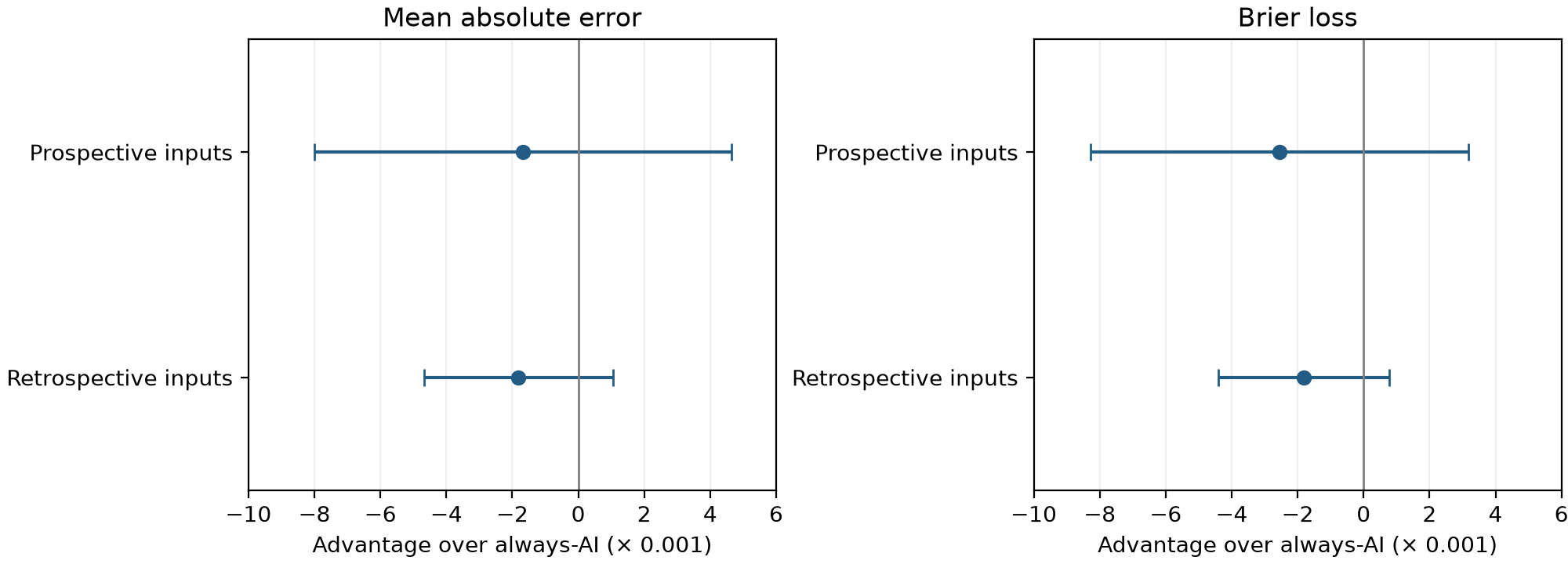
Figure 1. Positive values indicate lower loss than always showing AI. Bars are approximate 95% intervals that account for responses sharing a test reader or case, conditional on the fitted policies. Grouping responses by reader retains the dependence within each randomized sequence. Brier loss is squared probability error, evaluated with the same MAE-selected decisions. Neither policy had a positive Brier point estimate under the published reference.
Sensitivity to the reference labels
We scored the same decisions against three supplied sets of binary labels: the reference used in the published policy analysis, a US-expert reference and an all-group reference. The released materials identify the published endpoint as a CheXbert label, named for an automated system that labels chest X-ray reports, although its complete construction history remains unresolved. The alternatives were not identical: across 1,620 case–finding pairs in the full first-read sample, the published reference was positive in 7.22%, compared with 4.57% for each alternative.
The prospective policy's estimated MAE and Brier advantages were negative under all three scoring references. Only the reference and the regression models used to estimate performance changed; the policy and display threshold stayed fixed.
| Reference used to score the same decisions | MAE advantage | Brier advantage |
|---|---|---|
| Published reference | -0.001688 | -0.002551 |
| Supplied US-expert reference | -0.002823 | -0.003517 |
| Supplied all-group reference | -0.003898 | -0.004712 |
Table 1. Always-AI loss minus prospective-policy loss on the same 1,509 test encounters. All six approximate intervals included zero.
Against the US-expert reference, the MAE interval was −0.009766 to 0.004120 and the Brier interval was −0.009981 to 0.002947. These estimates leave the direction of the advantage uncertain. Their changes across references do not establish differences between references, and they evaluate the same policy rather than one trained to optimize expert agreement.
What changes when only cases are withheld
The case-only evaluation tested every case using one of five separately learned policies. Their pooled prospective display rate was 56.9% and their MAE advantage was 0.001655. Its point estimate changed to −0.000674 against the US-expert reference. These estimates describe multiple fitted policies rather than a single fixed policy, and opposite signs of uncertain estimates do not establish a difference between references.
All five case partitions contained responses from the same randomized reader sequences. Experimental conditions remained constant within 15-case blocks, so a training encounter's reader and block identified the AI exposure of every test encounter in that block. Case exclusion alone therefore failed to separate learning from test randomizations. This dependence exists whether or not the fitted decision trees exploited that information. An assignment probability of one half for each encounter does not supply the missing independence for a learned policy or the models used to evaluate it.
We assessed learning instability by resampling cases and refitting the complete case-only analysis 200 times. The central 95% range of prospective display frequency was 27.1%–82.7%, compared with 53.3%–60.1% when fixed decisions were merely reweighted on the same sampled cases. The wider range documents instability of that learning procedure conditional on readers and schedules. Neither this bootstrap resampling nor uncertainty intervals accounting for shared readers and cases repairs the dependence of learning on evaluation assignments. These case-only results are descriptive; the main evaluation uses the crossed holdout.
Interpretation
Selective whole-image display had no established advantage over always showing AI when both readers and cases were withheld. The small positive estimate from the case-only evaluation did not persist. The change cannot be attributed to bias from shared reader sequences alone: the crossed split also reduced training data and evaluated different readers and cases.
The original practical inference is weakened by the mismatch between finding-specific decisions and whole-image exposure, and by the lack of an established advantage in this first-read whole-image reanalysis. The added evidence concerns a policy whose action matches the experiment and whose evaluation is separated from the randomized reader sequences used to learn it. Incomplete numerical reproduction is a separate issue and does not establish incorrect published arithmetic.
The results support prospective testing rather than recommending selective display. Such a trial would need to fix the scoring reference, scoring rule and display policy before evaluation. Reduced display frequency alone does not establish better interpretation or safe withholding of assistance.
Methods
Data and experiment
We used openly downloadable Collab-CXR responses, survey metadata, and the authors' analysis dataset and implementation. Responses are licensed under Creative Commons Attribution 4.0 (CC BY 4.0), and policy code uses the MIT license. We fixed source revisions and recorded input hashes, identifiers used to verify file contents. The analysis required no restricted radiographs. [2–4]
The reanalysis used the experimental arrangement labeled design 1. Each reader interpreted 60 distinct cases, with 15 encounters in each combination of AI availability and clinical-history availability. All 24 possible condition sequences occurred. Conditions were constant within each 15-case block. The independently assigned unit was the reader's condition sequence, rather than an individual finding or encounter. To target first interpretation, we excluded design 2, which repeated cases across sessions, and design 3, which presented unaided readings before assisted readings. [2]
We averaged losses across five findings within each encounter: consolidation, or lung airspaces filled with material; atelectasis, or collapsed lung tissue; pneumothorax, or air around the lung; pleural effusion, or fluid around the lung; and cardiomegaly, or an enlarged heart. MAE is absolute probability error against a binary reference. Brier loss is squared probability error and is a proper probability score: its expected value is minimized by reporting the true event probability.
Learning and splitting
This was an exploratory reanalysis because outcomes had been inspected before the crossed evaluation. The crossed split and procedure were fixed before that evaluation, without selecting among seeds or learners using its test results. Random seed 20261101 independently shuffled readers and cases. Integer boundaries at 40% and 60% defined training, validation and test partitions. Encounters whose readers and cases belonged to different partitions, 6,132 in total, were unused. Test reader sequences were disjoint from both training and validation, and test cases were excluded from both.
The same learner and hyperparameters were used in the case-only and crossed evaluations. Prospective features were the five AI probabilities, history availability, years of experience and thoracic specialty. The latter two came from explicitly named survey questions about pre-existing characteristics. Retrospective inputs added the five released difficulty values and case-level AI accuracy. Their interpretation assumes supplied retrospective attributes are fixed; where constructed from trial responses, they lack the prospective policy's independence guarantee.
Training used estimated AI-minus-no-AI loss differences as targets for learning the policy. To construct these targets, we divided training readers and cases into four groups each. For each of the 16 intersecting cells, supporting regression models excluded both that cell's readers and its cases. Separate models predicted loss with and without AI using prospective inputs. We combined those predictions with observed errors weighted by treatment-assignment probabilities, using the augmented inverse-probability scores described below. This cross-fitting procedure supplied treatment-effect targets for a regression model that learned the policy.
All regressions used histogram gradient boosting, a method that combines decision trees, with 100 iterations, seven leaf nodes, minimum leaf size 50, L2 regularization 10, learning rate 0.05, no early stopping and random seed 42. Software was Python 3.12.16 and scikit-learn 1.9.1. Validation selected a threshold among 49 equally spaced prediction quantiles and always/never-display options, minimizing estimated MAE; ties favored always-AI. The policy displayed AI below the selected predicted-effect threshold. Test outcomes selected neither model nor threshold. Brier and alternative-reference evaluation retained those decisions.
Estimation and uncertainty
For each action, showing or withholding AI, the augmented score was its predicted loss plus twice the residual, the observed loss minus the prediction, if that action was assigned. Otherwise it was its predicted loss alone. A policy's estimated loss averaged the score of its chosen action. Evaluation regressions were fitted on training readers and cases only, separately by treatment arm, loss and reference, using prospective features. The plain inverse-probability estimate used twice the observed loss when assignment matched the policy and zero otherwise.
The factor of two uses marginal AI assignment probability 0.5, conditional on history and pretreatment characteristics under the stated sequence randomization. With independent reader sequences, neither the fixed prospective policy nor the evaluation regressions depend on test assignments through training responses. Under fixed reference labels, consistency between the assigned intervention and the action being evaluated, and no relevant carryover from earlier cases, the randomized residual corrects even an imperfect outcome regression. Dependence among responses from the same reader affects precision and is retained when grouping responses for uncertainty calculations.
For this single fitted policy, approximate intervals used a two-way sandwich variance, adding test-reader and test-case variance components and subtracting their intersection. We used a t critical value with 63 degrees of freedom, the smaller cluster count minus one. These intervals quantify evaluation uncertainty conditional on the fitted policy. They are neither finite-sample exact randomization intervals nor intervals for the performance of an algorithm retrained on new development samples. We also calculated estimates separately by history availability and diagnostics of the weights for encounters whose assigned action matched the policy.
Limits
The crossed holdout targets unseen readers and cases from this experimental population; extending it to the original participating-reader target requires assumptions about learning from shared sequences. Its smaller training and validation samples can reduce policy quality and make thresholds unstable. The analysis assumes independent assignment between readers and no relevant carryover across cases. All three references are fixed scoring targets, and none is assumed to represent independently confirmed disease; uncertain label provenance and retrospective attributes limit their interpretation. A single exploratory split and fixed learner cannot rule out better policies, and this offline experiment measures scored responses rather than clinical outcomes or patient safety.
References
- Nour R, Noor A. Context-aware AI assistance reduces diagnostic error in chest X-ray interpretation. Scientific Reports (2026).
- Moehring A, et al. A Dataset for Understanding Radiologist-Artificial Intelligence Collaboration. Scientific Data (2025).
- Nour R, Noor A. Collab-CXR adaptive-policy analysis repository. Pinned revision 284c436c20dc42147bf195c7a6eb4a1991f62b71.
- Collab-CXR. Public response data and dataset documentation repository. Response archive dated 16 September 2026; documentation revision 08690b905ed447e73f108211684bbe135230e141.