Accurate predictions of a MUC1 genetic marker can conceal large DNA-length errors
You are reading version 2. Read the latest version (3).
- Numbers reproduced
- Partly, limits of our recheck
- Original conclusion
- Weakened, newer data
The original estimate approximately reconstructs, but missing unrounded inputs, historical analysis settings and proxy phase limit exact reproduction rather than establish an original error; the matched five-variant estimate attenuates in overlapping newer outcome data, weakening the conclusion while leaving the MUC1 causal mechanism unresolved.
In plain English
The original study linked genetically higher magnesium to lower stroke risk. We approximately recovered its estimate, but the link became weaker with newer stroke data. Following an influential DNA marker, we found that published predictions could identify the marker correctly while badly mismeasuring a nearby repeated stretch of DNA. That stretch needs its own accuracy check before it can help explain the magnesium link. This work does not tell us whether magnesium supplements prevent stroke.
Published DNA predictions correctly recover a MUC1 splice-associated marker in 39 of 40 people, yet mismeasure the nearby repeat-spanning DNA length by more than 600 base pairs in 24 of those 39. In a matched subset of 17 people, median absolute length error falls from 2,112 base pairs with Illumina short reads to 15 with PacBio HiFi and 19 with Oxford Nanopore long reads. This distinction matters to a genetic argument linking higher magnesium to lower stroke risk. The influential MUC1 marker also tracks repeat length, so its accurate reconstruction cannot by itself establish which molecular feature explains the association. Our reanalysis shows why repeat length needs its own validation before it can help resolve that mechanism.
Background
Larsson and colleagues reported that a genetically predicted 0.1 mmol/L increase in serum magnesium was associated with an odds ratio of 0.63 for cardioembolic stroke, a stroke caused by a clot originating in the heart [1]. They used Mendelian randomization, which combines genetic variants associated with an exposure to estimate its effect on an outcome. Because inherited variants precede disease, this approach can strengthen causal inference beyond an ordinary association between blood magnesium and stroke. Its central requirement is that the selected variants influence stroke through magnesium rather than through another pathway.
One of the six magnesium variants was rs4072037 at MUC1. This single-nucleotide polymorphism (SNP), a variable DNA base, affects how the gene's RNA is spliced. It lies near a coding tandem repeat, a stretch of repeated DNA whose length varies between people. MUC1 variants also associate with kidney-related blood measurements, and published work links repeat variation to urea and urate [5]. These observations leave several possible explanations for the magnesium association. Splicing could matter, repeat variation could matter, or another linked feature could matter. A kidney association alone does not establish that the variant violates the assumptions of Mendelian randomization.
We began by updating the stroke data while retaining the original magnesium calibration. The weaker estimate led us to examine MUC1, then to ask whether available sequence predictions could reliably measure its repeat. Two distinctions are needed to follow the evidence. First, fine-mapping narrows an association to a set of candidate variants, called a credible set, but an analysis restricted to SNPs cannot directly evaluate an unmeasured repeat. Second, reconstructing a marker correctly and reconstructing a repeat's length correctly are separate tests. We examined both using published assemblies and predictions [6–8].
Results
Updating the stroke association
The estimated protection becomes smaller in newer stroke data even though precision improves. The original six-variant estimate approximately reconstructs as an odds ratio of 0.627 (95% confidence interval 0.494–0.796), close to the reported 0.63. For the update, we compared five exact variants available in both MEGASTROKE and European GIGASTROKE, using the original magnesium effects in mmol/L [1–3]. The sixth target was represented by a proxy in the historical analysis; its direct target was absent at the queried coordinate in the later release, and we could not recover the proxy's allele phase.
Table 1. Matched-variant outcome update. Odds ratios are per 0.1 mmol/L higher genetically proxied magnesium. Fixed-effect estimates combine variant-specific estimates by inverse variance. Multiplicative random-effects intervals allow excess variation between those estimates, but do not correct invalid instruments. The two outcome datasets overlap.
| Outcome and instruments | Fixed-effect OR (95% CI) | p | Random-effects OR (95% CI) | p |
|---|---|---|---|---|
| MEGASTROKE, five direct variants | 0.649 (0.500–0.842) | 0.00115 | 0.649 (0.445–0.945) | 0.0242 |
| GIGASTROKE, five direct variants | 0.865 (0.694–1.078) | 0.197 | 0.865 (0.649–1.152) | 0.32 |
| MEGASTROKE, four, excluding MUC1 | 0.848 (0.588–1.222) | 0.376 | 0.848 (0.552–1.302) | 0.45 |
| GIGASTROKE, four, excluding MUC1 | 0.991 (0.735–1.336) | 0.952 | 0.991 (0.674–1.456) | 0.963 |
With the same five variants, the odds ratio changes from 0.649 to 0.865, while the standard error on the log-odds scale decreases from 0.133 to 0.113. MUC1 contributes 45.4% of the later statistical weight. Removing it brings the later estimate to 0.991 (0.735–1.336), showing its influence without establishing that it is an invalid instrument.
The newer data weaken the original large protective estimate. We do not find evidence that Larsson and colleagues' original calculation was wrong. Exact reproduction is limited by missing unrounded inputs, historical analysis settings and proxy phase; the attenuation comes from updating the outcome data. Evidence for protection remains possible: the later random-effects interval is 0.649–1.152, and excluding the historical TRPM6 outlier gives 0.772 (0.607–0.983), although that result misses the original multiple-testing threshold. GIGASTROKE includes 10,804 European cardioembolic cases, with 6,189 from unchanged cohorts, 718 from updated cohorts and 3,897 from new cohorts. These classifications do not give participant-level overlap. The update therefore cannot serve as an independent replication or a formal test of change between the two correlated estimates.
MUC1 candidate variants and repeat length
Both the magnesium and kidney-trait SNP candidates track MUC1 length, despite belonging to separate European fine-mapping sets. Independent Million Veteran Program data support the magnesium association of rs4072037 in European- and African-ancestry participants [4]. In the published European fine-mapping, the magnesium component containing rs4072037 has two candidates, rs4072037 and rs12743084. The latter has the larger posterior inclusion probability, 0.673. A second magnesium component contains four other SNPs. Blood urea nitrogen, creatinine and estimated glomerular filtration rate each have a retained single-SNP component at rs6676150, which is absent from both magnesium sets. African-ancestry and admixed-American sets overlap, so the European separation is not universal. None of these models included the tandem repeat.
We tested whether the candidate SNPs distinguish length using a public assembly and predicted-protein resource from a preprint [6]. After requiring complete protein pairs, available genotypes and one person per connected pedigree family, 206 participants remained. Adjusting for source population, each rs4072037 T allele was associated with a 572-amino-acid decrease in the sum of the two protein lengths (95% CI 501–643 fewer), while each rs6676150 C allele was associated with a 570-amino-acid increase (499–640). Their partial R² values, the fractions of residual length variation explained after population adjustment, were 0.651 and 0.613.
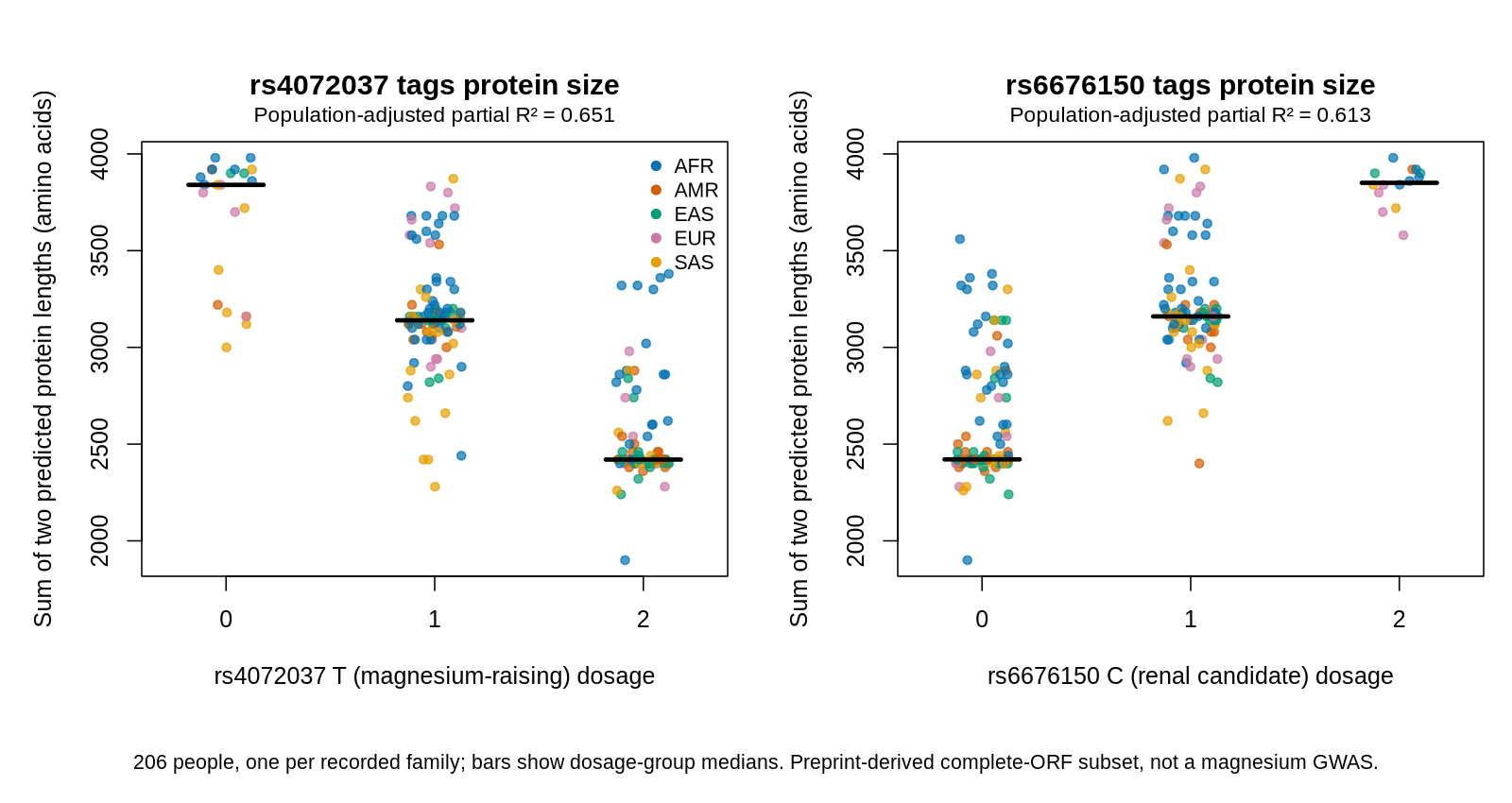
Figure 1. Both candidate SNPs track assembly-derived MUC1 protein size. Points represent retained participants, coloured by source superpopulation; black bars mark unadjusted dosage-group medians. Dosage is the number of copies of the indicated allele. Partial R² adjusts for 25 source populations. Protein size is not an exact repeat count.
Both associations persist within the 25 European participants, with partial R² of 0.694 and 0.739. This small subgroup cannot separate their conditional effects: intervals include zero when both SNPs enter the model. The other magnesium candidate, rs12743084, is unavailable as a SNP in the high-coverage release used for these fits. In a smaller phase-3 subset, its G dosage equals rs4072037 T dosage in all 94 retained people, leaving those candidates indistinguishable there.
Selection for complete proteins does not account for the dual tagging. Only 486 of 592 source haplotype entries have complete proteins. We therefore measured a DNA interval between unique sequences flanking the repeat in an older 44-person assembly panel, without requiring complete protein sequences [7,8]. In the 34-person population-adjusted analysis, rs4072037 T predicts 1,782 fewer base pairs (95% CI 1,069–2,494 fewer), and rs6676150 C predicts 2,065 more (1,274–2,856). Both associations persist after excluding people flagged for MUC1 assembly quality in a newer release. This panel overlaps the protein resource and contains no European participants, but it shows that the association is observable without complete-protein selection.
Accuracy of predicted repeat-spanning length
Correct splice-marker predictions frequently coexist with large length errors in the published Illumina benchmark. Before using a larger predicted-haplotype resource to extend the reference analysis, we checked its accompanying benchmark. The archived release identifies the predictions as Locityper version 0.17.3 [8]. We reconstructed the reported haplotype pairs and compared their summed repeat-spanning lengths with the assembly reference.
In the leave-one-out setting, which excludes each target person's reference haplotypes, 39 of 40 rs4072037 dosages are correct. Yet 24 of those 39 predictions have absolute diploid length errors above 600 base pairs. Across all 40 people, 25 errors exceed that threshold; median absolute error is 2,001 base pairs and mean signed error is −1,346 base pairs, indicating average underestimation. Squared correlation between predicted and reference length is 0.337. Prediction R², which also penalizes systematic error, is −0.587: predicting the reference mean would have a smaller total squared error. Even in the full-panel setting, where the target's own haplotypes are available, all 40 SNP dosages are correct while 23 length errors exceed 600 base pairs.
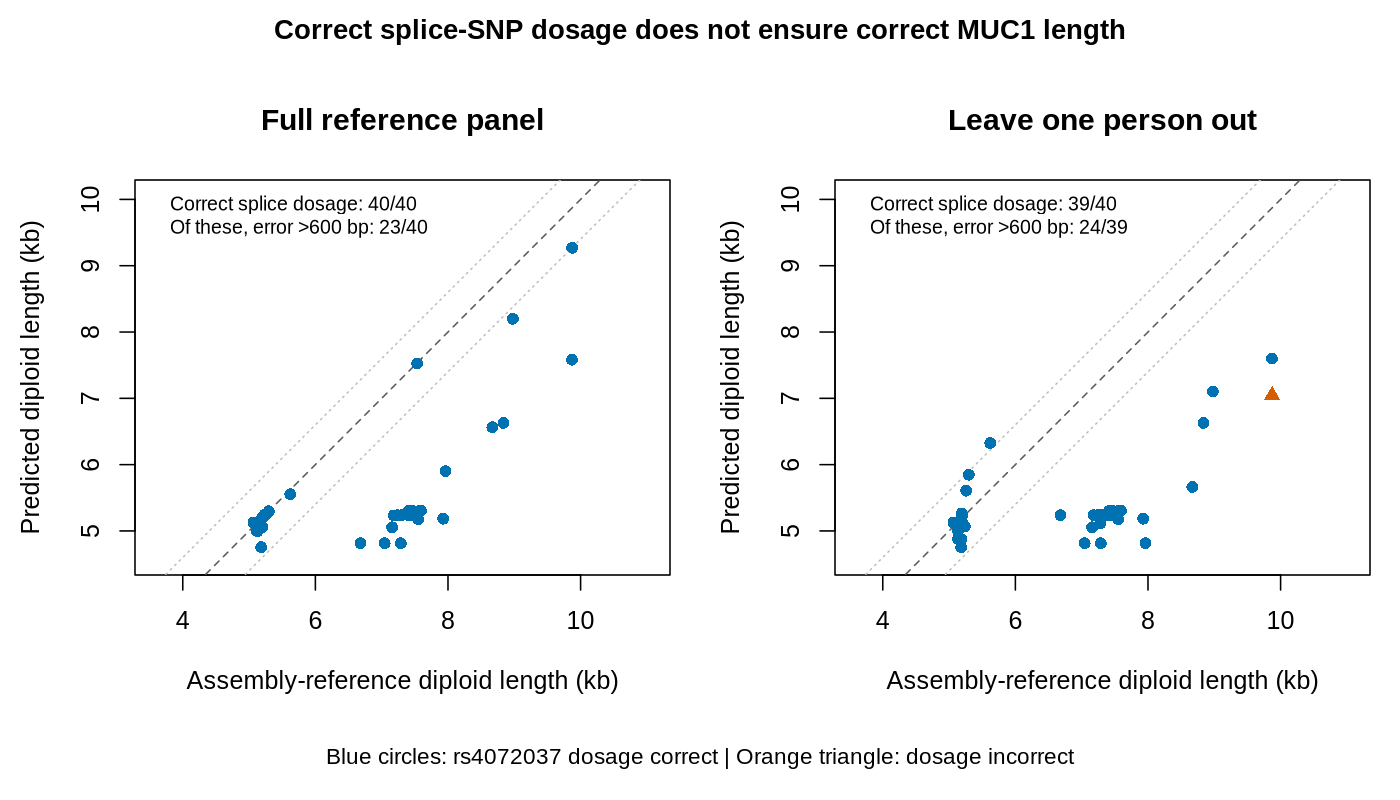
Figure 2. Published Illumina predictions recover the splice marker more reliably than length. Both panels contain the same 40 people. Blue circles indicate correct rs4072037 dosage; the orange triangle indicates an incorrect dosage. The dashed line marks agreement and dotted lines mark ±600 base pairs. Length sums the two repeat-spanning DNA intervals, including fixed flanks. Assemblies provide the reference comparison rather than independently established sequence truth. Overlapping points are not jittered.
Available reference lengths are close enough that their absence cannot explain these large errors. After excluding each target's haplotypes and all sequence-identical aliases, we enumerated the remaining pairs. For every target, a pair with the correct splice-allele composition lies within 9 base pairs of the reference diploid length. Because opposite errors in two copies could cancel, we also searched separately for each copy's nearest length with the same splice allele. The largest nearest-copy difference was 241 base pairs. These searches use known reference lengths and cannot be used as predictors; they establish length availability, not whole-sequence similarity or predictability from reads.
Comparison of read inputs
Long-read inputs greatly reduce length errors in the same people. We reconstructed all 248 published MUC1 predictions across Illumina, PacBio HiFi, Oxford Nanopore and simulated short reads, in both reference settings. Technology comparisons use only people present in both datasets.
Table 2. Paired absolute diploid length errors. Each comparison uses its own sample intersection. Full-panel predictions can use the target's reference haplotypes; leave-one-out predictions exclude them. ONT denotes Oxford Nanopore. Counts are descriptive, not independent trials.
| Reference setting | Comparator | Paired n | Illumina median error (bp) | Comparator median error (bp) | Errors >600 bp: Illumina / comparator |
|---|---|---|---|---|---|
| Full panel | HiFi | 17 | 1998 | 0 | 10 / 0 |
| Full panel | ONT | 17 | 1998 | 6 | 10 / 0 |
| Full panel | Simulated short reads | 40 | 1906 | 0 | 23 / 0 |
| Leave one out | HiFi | 17 | 2112 | 15 | 11 / 2 |
| Leave one out | ONT | 17 | 2112 | 19 | 11 / 0 |
| Leave one out | Simulated short reads | 40 | 2001 | 109.5 | 25 / 9 |
Among the 17 matched people, leave-one-out median absolute error falls from 2,112 base pairs with Illumina to 15 with HiFi and 19 with Oxford Nanopore. Oxford Nanopore improves all 17 predictions and brings all 11 Illumina errors above 600 base pairs below that threshold. HiFi improves 16 of 17, with two errors remaining above 600 base pairs. The contrast persists after excluding newer assembly-quality flags and after requiring complete newer protein pairs. Matching predicted and reference copies by length also shows improvement, so the diploid result is not simply cancellation between the two copies.
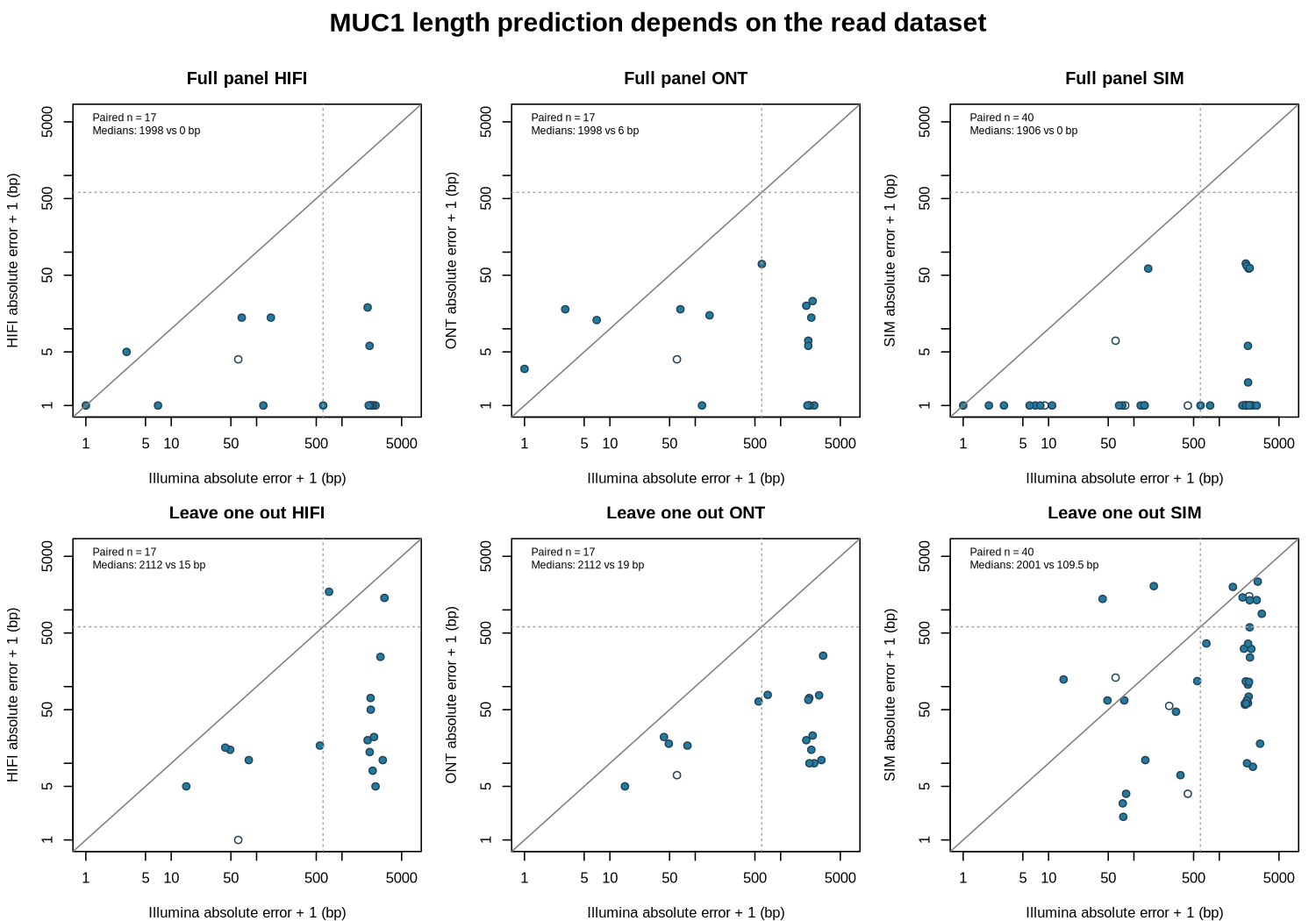
Figure 3. Each point compares one person's absolute length error under two published read inputs. Points below the diagonal favour the comparator. Axes show absolute error plus one base pair on logarithmic scales; dotted lines mark 600-base-pair errors. Open points identify people flagged at MUC1 in a newer assembly release. SIM denotes simulated short reads. Overlapping points are not jittered.
Simulated short reads also perform better than the real Illumina data. Among 40 paired targets, full-panel simulation has no errors above 600 base pairs, compared with 23 for Illumina; leave-one-out simulation has nine, compared with 25. The method can therefore select suitable lengths under some read-input conditions. These comparisons do not isolate a cause of the real short-read errors, such as library preparation, alignment or sequence composition.
Interpretation
The central result is an endpoint-specific measurement failure: accurate MUC1 splice-marker calls can accompany inaccurate repeat-spanning lengths. The matched long-read results show that this failure depends on the read inputs and benchmark setting. They also make a blanket judgment against the genotyping method unwarranted.
This matters because both magnesium and kidney-trait SNP candidates track length. Separate SNP credible sets cannot establish that one trait acts through splicing while another acts through the repeat. To distinguish those explanations, a magnesium cohort needs repeat measurements validated for length, alongside splice-marker genotypes. Jointly fitting them would address the causal question more directly than adding further estimators to the same small set of magnesium instruments. Validation should include long and short alleles and assess errors within splice-genotype groups, using measurements independent of the prediction inputs.
The limits are consequential. This is an exploratory investigation of one influential locus and a version-specific reanalysis of published predictions, not a new run of current software or an estimate of genome-wide error. Assemblies and predicted proteins are imperfect references. The small nucleotide benchmark lacks European participants; read technologies were neither randomized nor depth matched, and long-read inputs may share evidence with the reference assemblies. Simulations were generated from assemblies [7]. Repeat composition or another linked variant could still explain the association. The stroke update uses overlapping cohorts and permits appreciable protection, so it neither establishes the molecular cause of the historical signal nor estimates the benefit or safety of magnesium supplements.
Methods
The investigation proceeded from the stroke update to exploratory MUC1 analyses. We harmonised effect alleles for five exact variants in MEGASTROKE and European GIGASTROKE, retaining the original exposure effects in mmol/L. We combined variant-specific ratio estimates by fixed-effect inverse-variance weighting and used multiplicative random-effects intervals to allow overdispersion. Exclusion analyses assessed each variant's influence. Exposure-effect uncertainty and cohort overlap remain sources of uncertainty. Published Million Veteran Program credible sets were compared by membership; they were not refitted or treated as formal tests of a shared causal variant.
For the protein analysis, we retained complete pairs of predicted proteins, matched SNP calls across releases with explicit allele orientation, and selected one person per connected pedigree family. Linear regressions used the sum of both protein lengths as the outcome, source-population fixed effects and HC3 heteroskedasticity-consistent standard errors. Confidence intervals used residual-degrees-of-freedom t distributions. Singleton populations contributed no within-population information and were excluded from adjusted fits. Partial R² measured the reduction in residual sum of squares on adding a SNP.
For nucleotide lengths, we located unique 31-base anchors centred at GRCh38 chromosome 1 positions 155188400 and 155192100. The distance between their starts spans the repeat and fixed flanks. We read rs4072037 from a unique sequence context with its central base masked during matching. Summing the two copies avoided assumptions about phase labels across resources. Published predicted haplotype pairs supplied lengths and splice dosages for all four read technologies and both reference settings. Absolute error measured discrepancy from the assembly reference; signed error was predicted minus reference length. Prediction R² was one minus the sum of squared errors divided by the centred reference sum of squares. The 600-base-pair threshold was a descriptive diagnostic retained from the earlier audit, not a clinical cutoff; continuous errors were also assessed.
The reference-availability analysis excluded target haplotypes and sequence-identical aliases, permitted repeated haplotypes in a pair, and searched both unrestricted and splice-matched pools. Diploid and per-copy minima were calculated separately and need not use the same reference pair. Technology contrasts used one-to-one participant matches. Per-copy error used optimal length matching without assuming phase or splice matching. Reference-quality exclusions were sensitivity analyses performed after the initial results. No parameter was tuned to improve the technology comparisons.
Source checksums verified the retained data. Independent R calculations re-extracted sequence lengths and alleles and checked all 248 predictions, 88 reference-availability rows and 48 aggregate summaries, with a maximum numerical difference of 4.44 × 10⁻¹⁶. Separate checks covered the stroke estimates, credible-set extraction and length regressions. These checks establish computational agreement; the biological interpretation depends on the assumptions described above.
References
- Larsson SC et al. (2019). Serum magnesium and calcium levels in relation to ischemic stroke: Mendelian randomization study. Neurology.
- Meyer TE et al. (2010). Genome-Wide Association Studies of Serum Magnesium, Potassium, and Sodium Concentrations Identify Six Loci Influencing Serum Magnesium Levels. PLoS Genetics.
- Mishra A et al. (2022). Stroke genetics informs drug discovery and risk prediction across ancestries. Nature. European cardioembolic outcome GCST90104541.
- Verma A et al. (2024). Diversity and scale: Genetic architecture of 2068 traits in the VA Million Veteran Program. Science, Supplementary Table S11.
- Mukamel RE et al. (2021). Protein-coding repeat polymorphisms strongly shape diverse human phenotypes. Science.
- Plender EG et al. (2026). Complex structural variation, phylogeny, and disease associations of the mucin pangenome. medRxiv, version 1; preprint, not peer reviewed.
- Prodanov T et al. (2025). Locityper enables targeted genotyping of complex polymorphic genes. Nature Genetics.
- Prodanov T (2025). Locityper loci database, 1KGP genotypes and benchmarking data. Version-specific Zenodo release; README identifies benchmark predictions as v0.17.3.